Featured Projects
Real projects I've built to solve interesting problems — not just tutorials, actually working systems
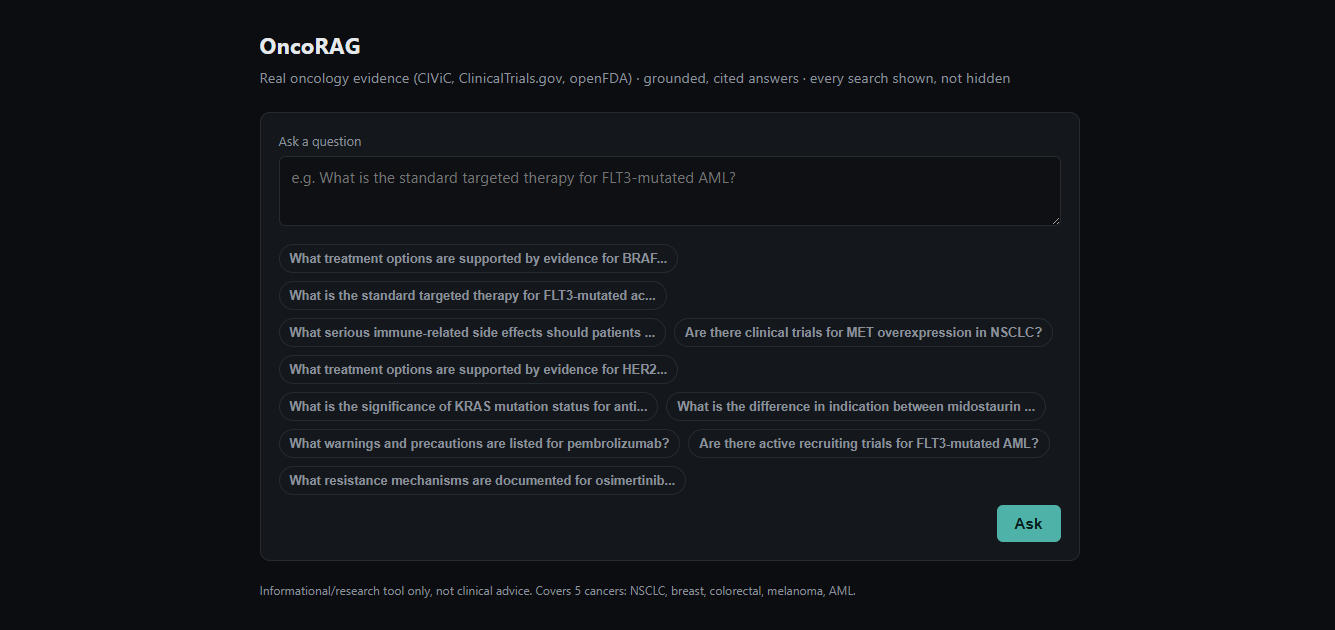
Production RAG + agentic oncology knowledge system on Weaviate hybrid search, grounded in real CIViC, ClinicalTrials.gov, and openFDA data across five cancer types. A transparent, citation-backed Claude Sonnet 5 agent exposes its full search trace and sources for every answer — empirically tuned, grounding-evaluated, and adversarially red-teamed rather than left at library defaults.

Technical Implementation
- Retrieval: Single Weaviate KnowledgeObject collection (the free tier's one-collection cap forced an object_type discriminator over cancer/gene/drug/evidence_item/clinical_trial/drug_label) with hybrid search tuned via paired bootstrap to alpha 0.75 with relative-score fusion
- Agent: Hand-rolled tool-use loop rather than Anthropic's Tool Runner, so every search call and citation stays traceable end-to-end for the UI's reasoning trace view
- Data Ingestion: CIViC, ClinicalTrials.gov, and openFDA clients feeding a chunking pipeline into the vector index
- Serving: FastAPI (/chat, /health, /examples) with per-IP rate limiting (20 questions/day) and an admin bearer-token bypass for eval and red-team scripts
- Rejected optimization: cross-encoder reranking was built and measured, then shipped as an opt-in extra — it hurt retrieval quality and added 4.46s of latency per query
Evaluation
- Hybrid search alpha/fusion swept and validated against a hand-verified golden eval set (a first version was found circular and rebuilt before any tuning ran)
- Agent eval: 28/28 tool-call rate, 28/28 grounding-clean, 25/28 citation ID-match
- Red-team: 10/10 held against jailbreaks, system-prompt extraction, social-pressure grounding bypass, and misinformation — run against the live deployed agent over real HTTP
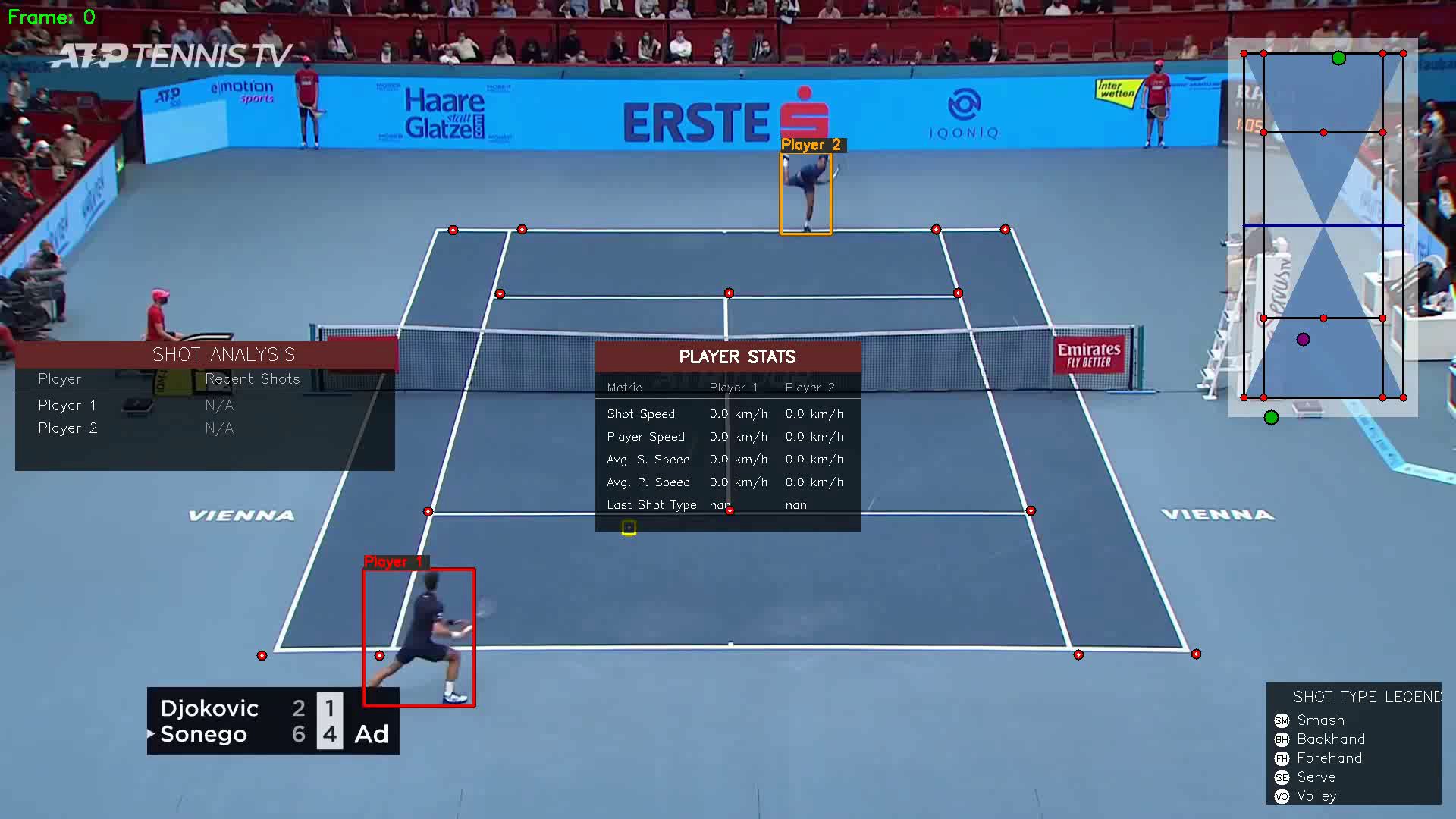
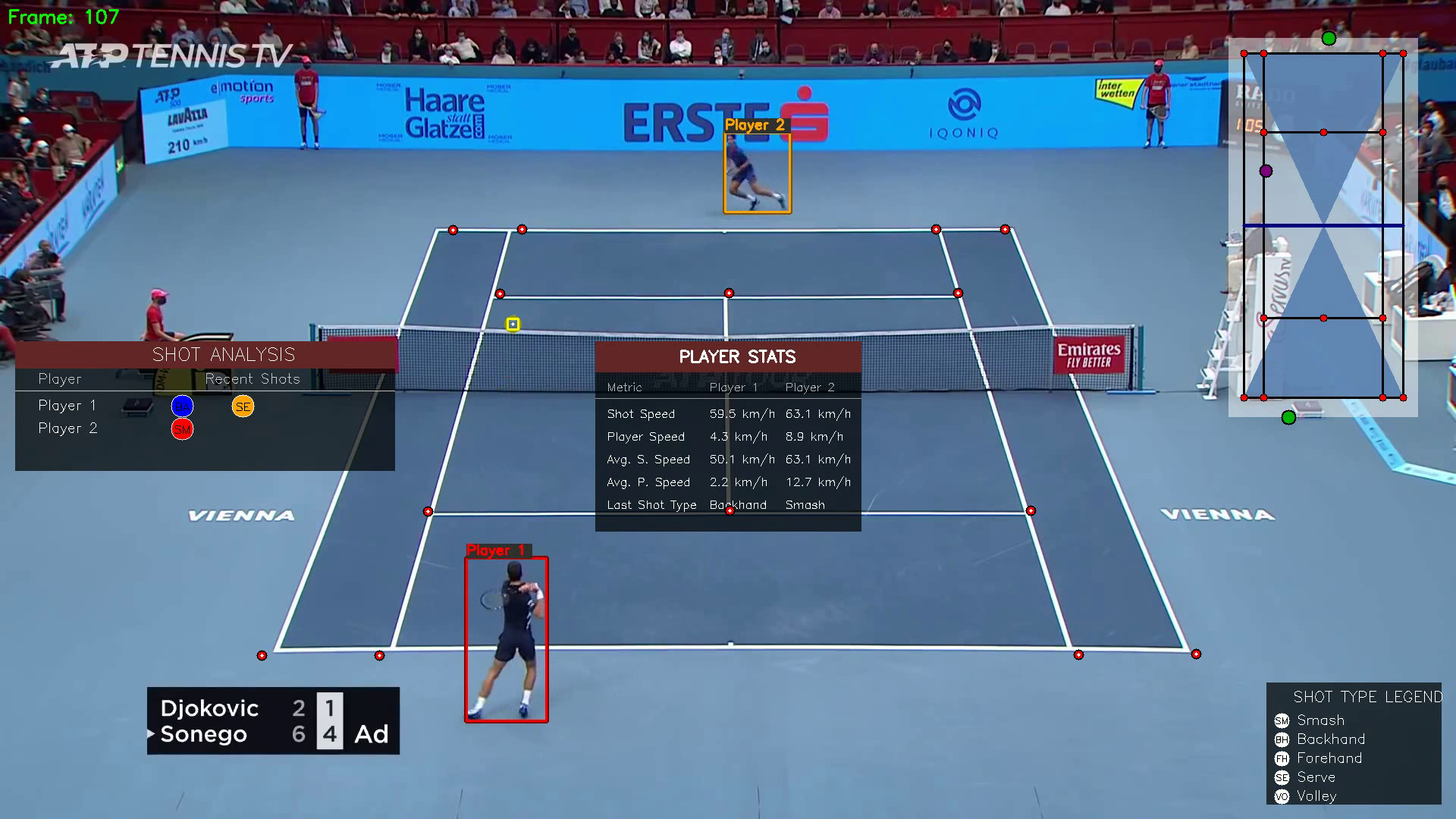
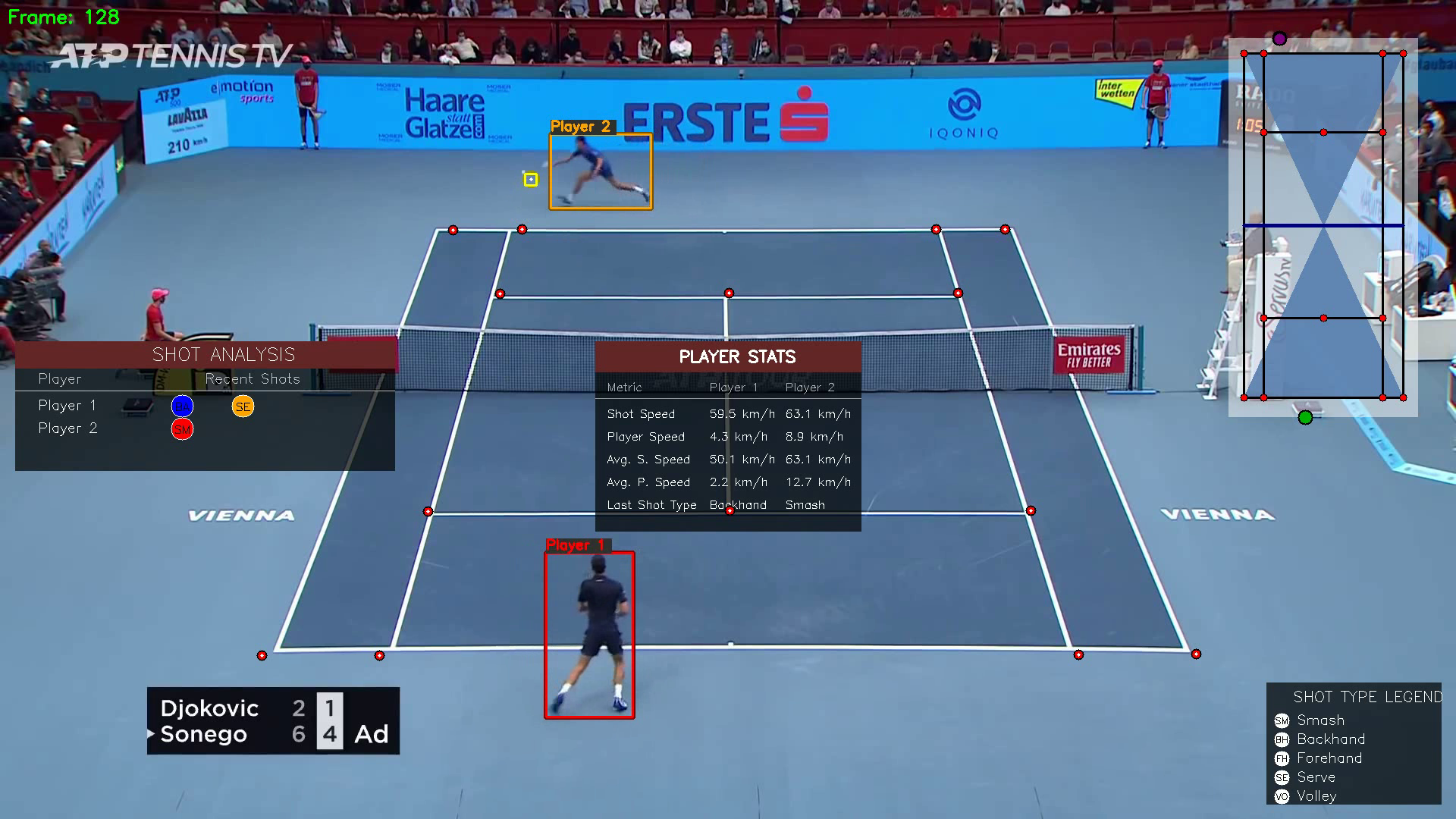
Advanced computer vision system for comprehensive tennis match analysis achieving 95% player detection accuracy and 88% ball tracking precision. Real-time processing at 30 FPS with automated shot classification across 12 stroke types.
Technical Implementation
- Player Detection: YOLOv8x achieving 92.8% mAP@0.5 with confidence threshold 0.7 and size filtering (20x50px minimum)
- Ball Tracking: Custom YOLOv8 model trained on 578 images achieving 87.3% mAP@0.5 with polynomial interpolation for smooth trajectories
- Court Detection: ResNet-50 based keypoint detection for 14 landmarks with 91.5% accuracy within 5-pixel tolerance
- Shot Classification: Rule-based classifier with 89.4% accuracy analyzing player position, ball trajectory, and temporal context
- Performance: 6.67 FPS processing speed with 94% memory reduction through ROI optimization
Key Features
- Real-time player tracking with position heatmaps and movement analysis
- Ball trajectory visualization with shot moment identification
- Automated classification: Serve (95.2%), Forehand (87.8%), Backhand (86.1%), Volley (91.3%), Smash (93.7%)
- Mini-court visualization providing bird's-eye view of match dynamics
- Comprehensive statistics dashboard with player speeds and shot analytics
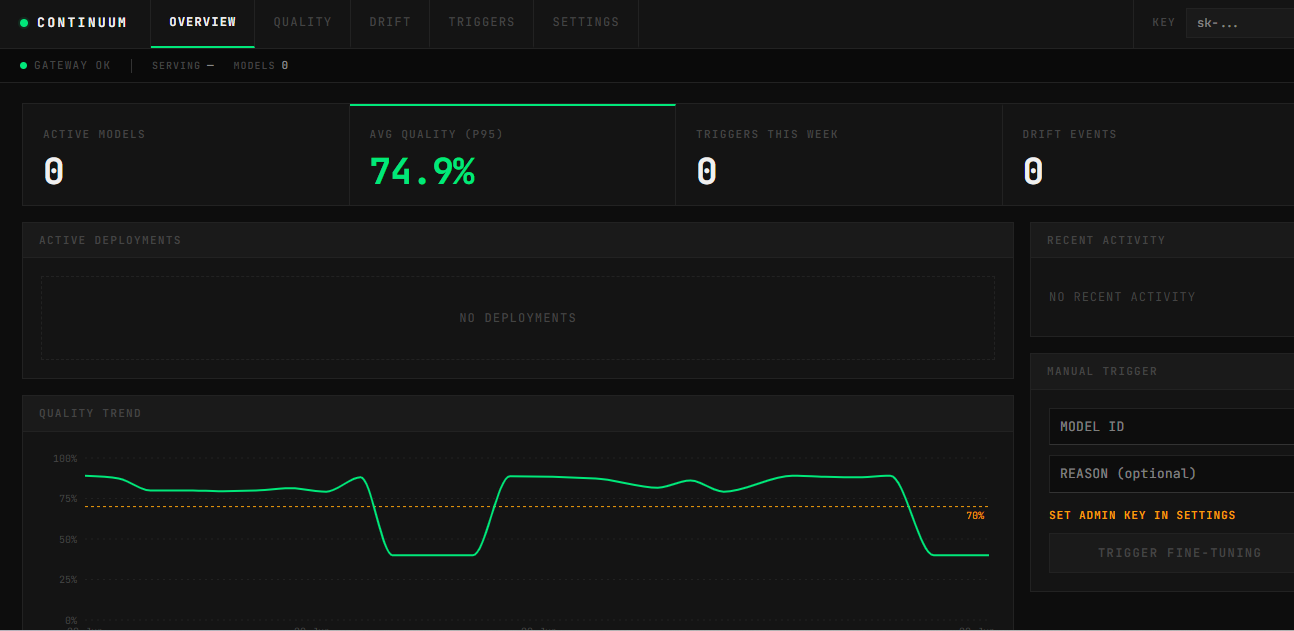
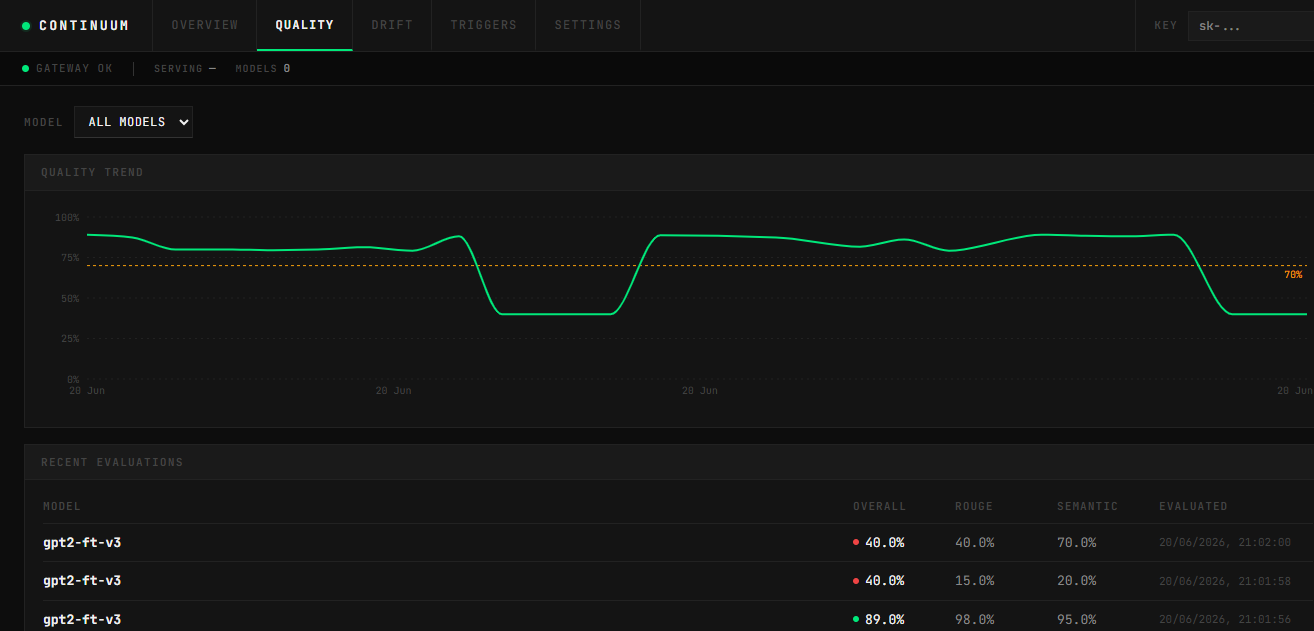
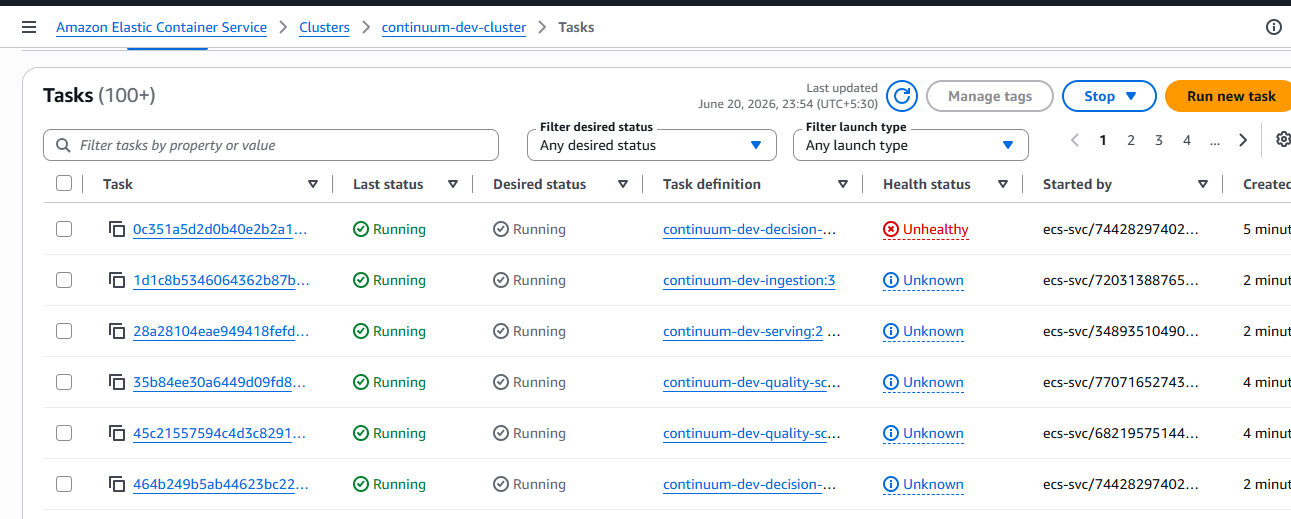
Production LLMOps platform for monitoring LLM quality and detecting behavioural drift in deployed models. 11-microservice event-driven architecture on AWS ECS Fargate, Apache Kafka trace pipeline, multi-dimensional quality scoring with a Claude LLM-judge, and Statistical Process Control for drift detection. Designed self-healing LoRA fine-tuning loop with A/B canary deployment.
Architecture
- Event-Driven Pipeline: Apache Kafka (KRaft mode, 10 topics) captures every production LLM trace in real time; 11 microservices on AWS ECS Fargate handle ingestion, scoring, storage, alerting, and orchestration
- Quality Scoring: Multi-dimensional scorer combining Claude LLM-judge + ROUGE/BLEU + semantic similarity; each response gets a composite score per trace
- Drift Detection: Statistical Process Control (Western Electric rules) applied to quality score time-series; alerts fire when the distribution shifts beyond control limits
- Self-Healing Loop: Designed LoRA fine-tuning orchestration to automatically remediate detected drift with A/B canary deployment; full Terraform IaC
- Observability: 166 Prometheus metric series, Grafana dashboards, authenticated REST API, React/TypeScript frontend
Results
- Verified end-to-end trace flow: Kafka → scoring → PostgreSQL → alerting
- 10/10 passing E2E tests; 166 Prometheus metric series across all services
- Full Terraform IaC + GitHub Actions CI/CD
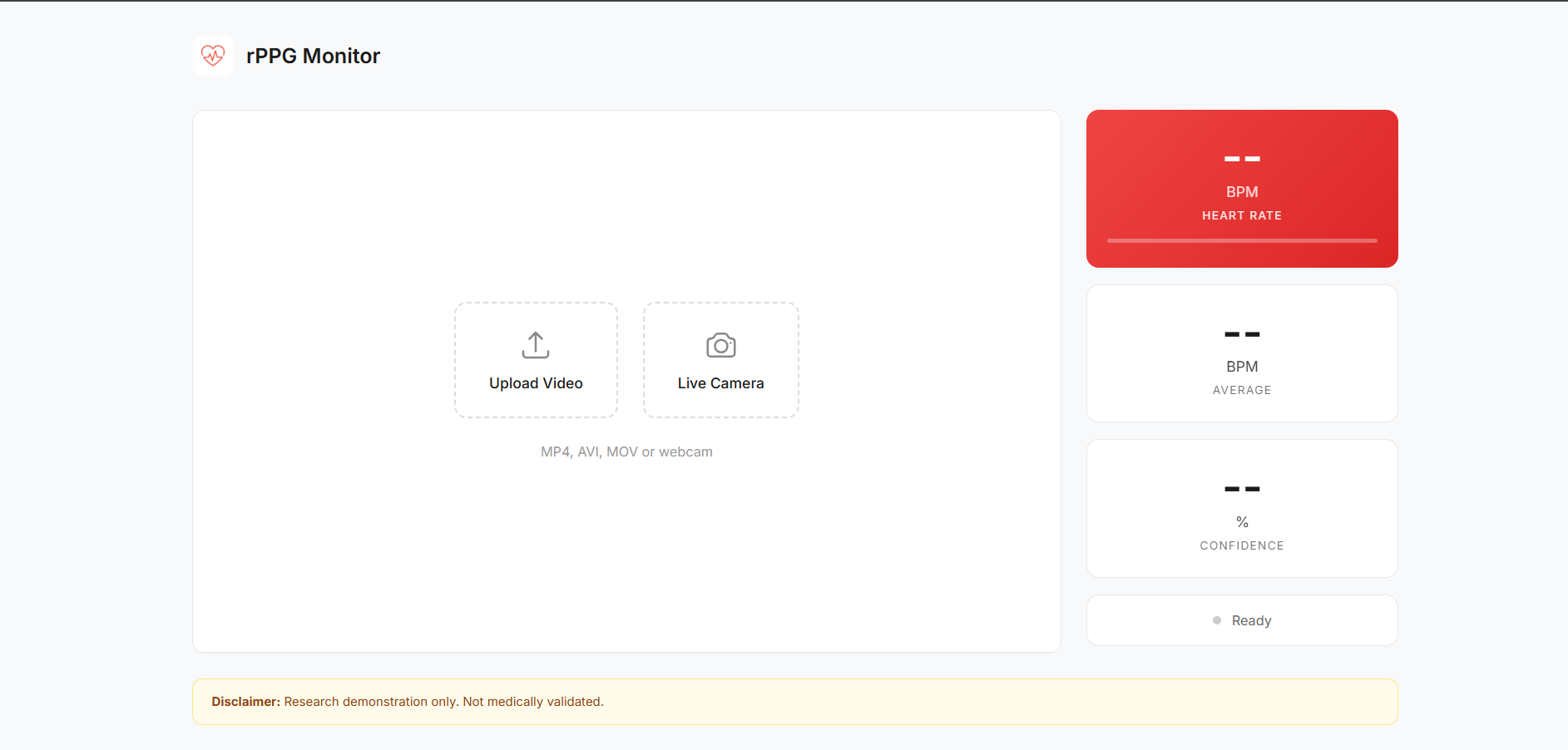
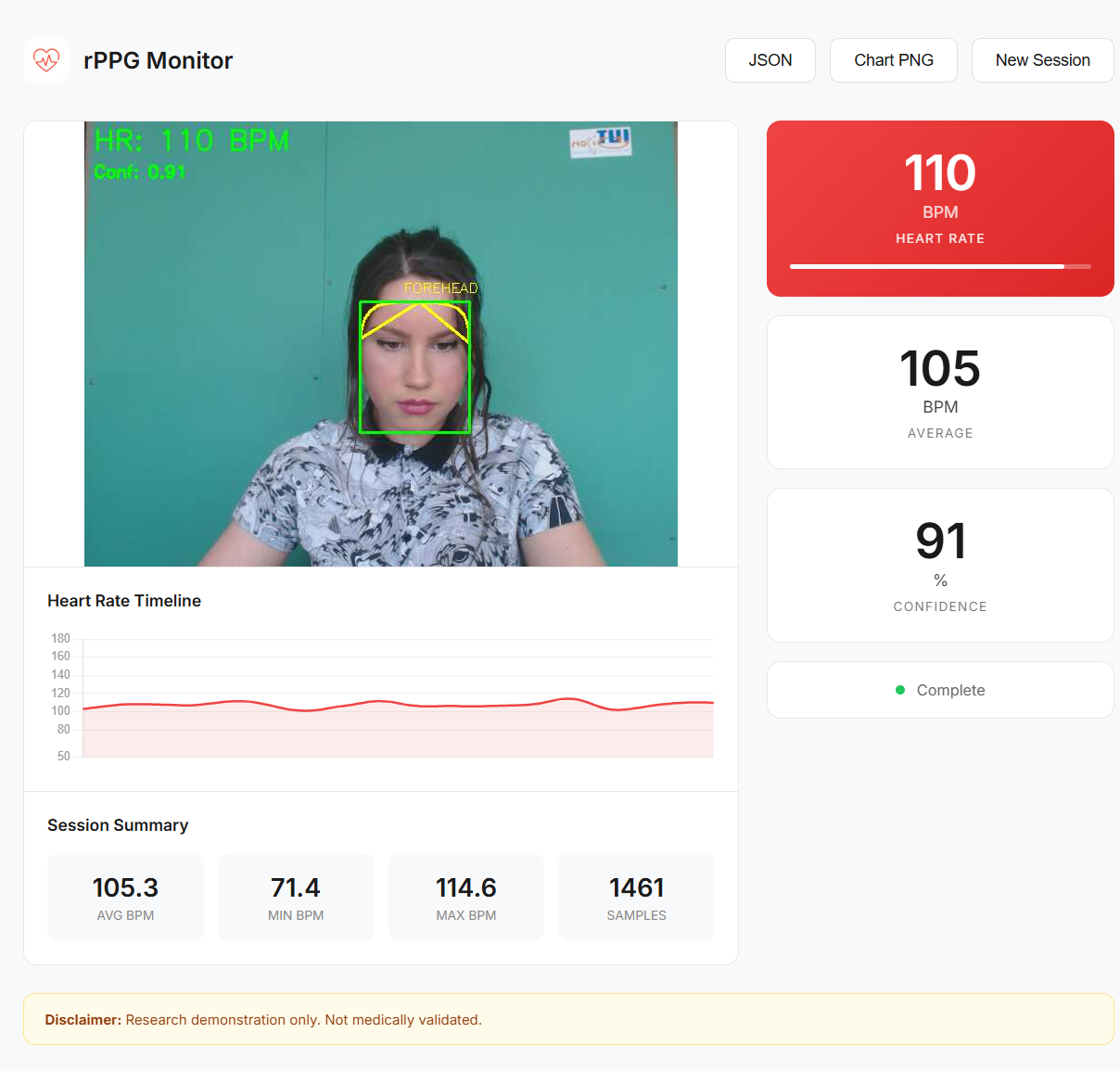
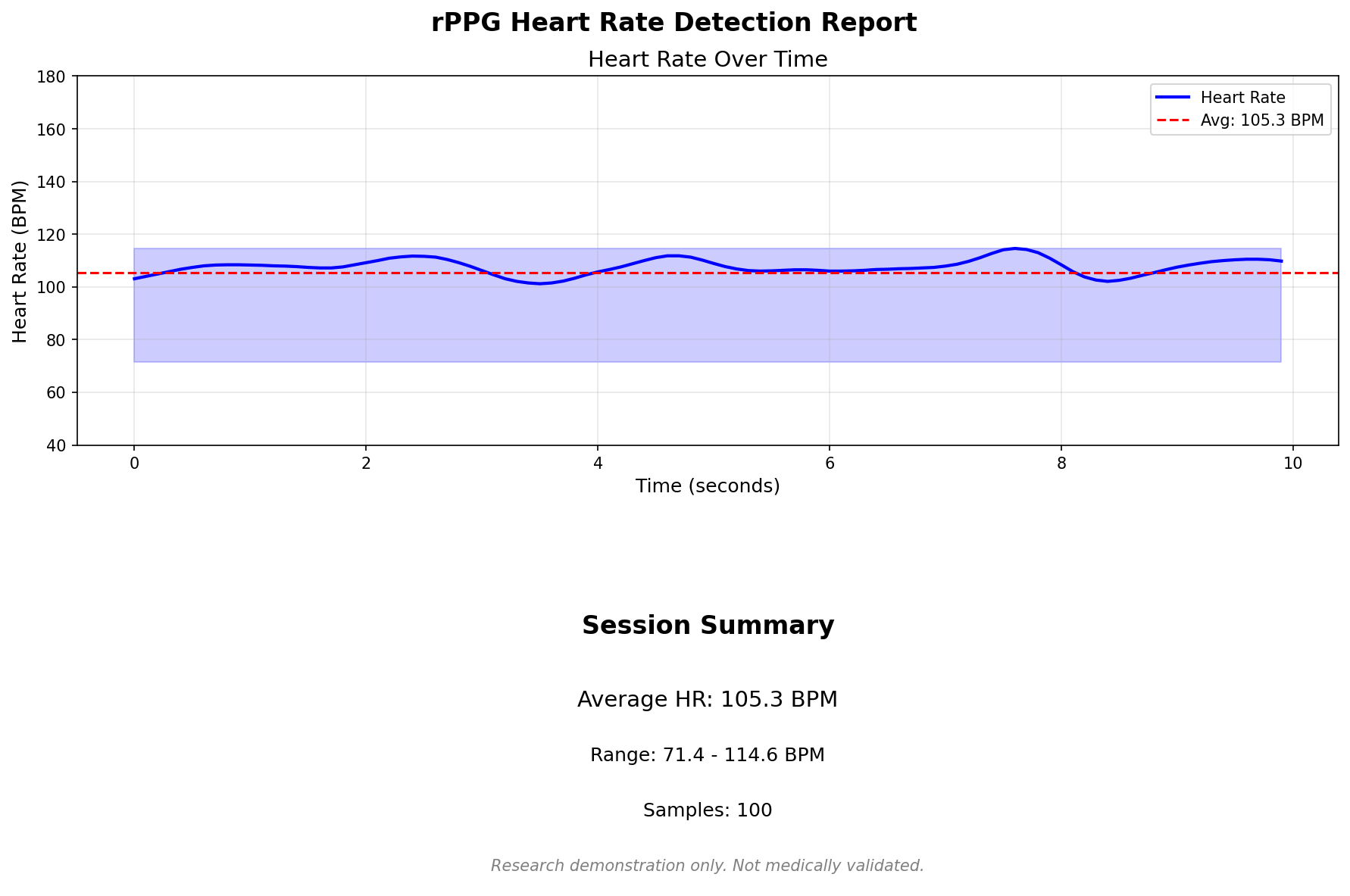
Contactless heart-rate estimation from face video — no sensors required. Hybrid pipeline combining classical signal-processing algorithms (CHROM, POS) with the PhysNet deep learning model, trained on the UBFC-rPPG dataset. Deployed as a real-time web application with ONNX export for fast CPU inference.
Technical Implementation
- Problem: Extract heart rate from subtle (~1% brightness) periodic skin-colour variations in webcam video without physical contact sensors
- Classical Methods: CHROM and POS algorithms for signal extraction from facial ROI — lightweight, interpretable, zero GPU requirement
- Deep Learning: PhysNet convolutional model trained on UBFC-rPPG benchmark dataset for improved accuracy under varied lighting conditions
- ONNX Export: Model exported to ONNX runtime enabling ~12 FPS real-time inference on CPU without GPU dependency
- Deployment: FastAPI backend + web dashboard with per-method confidence scoring and signal-quality indicators
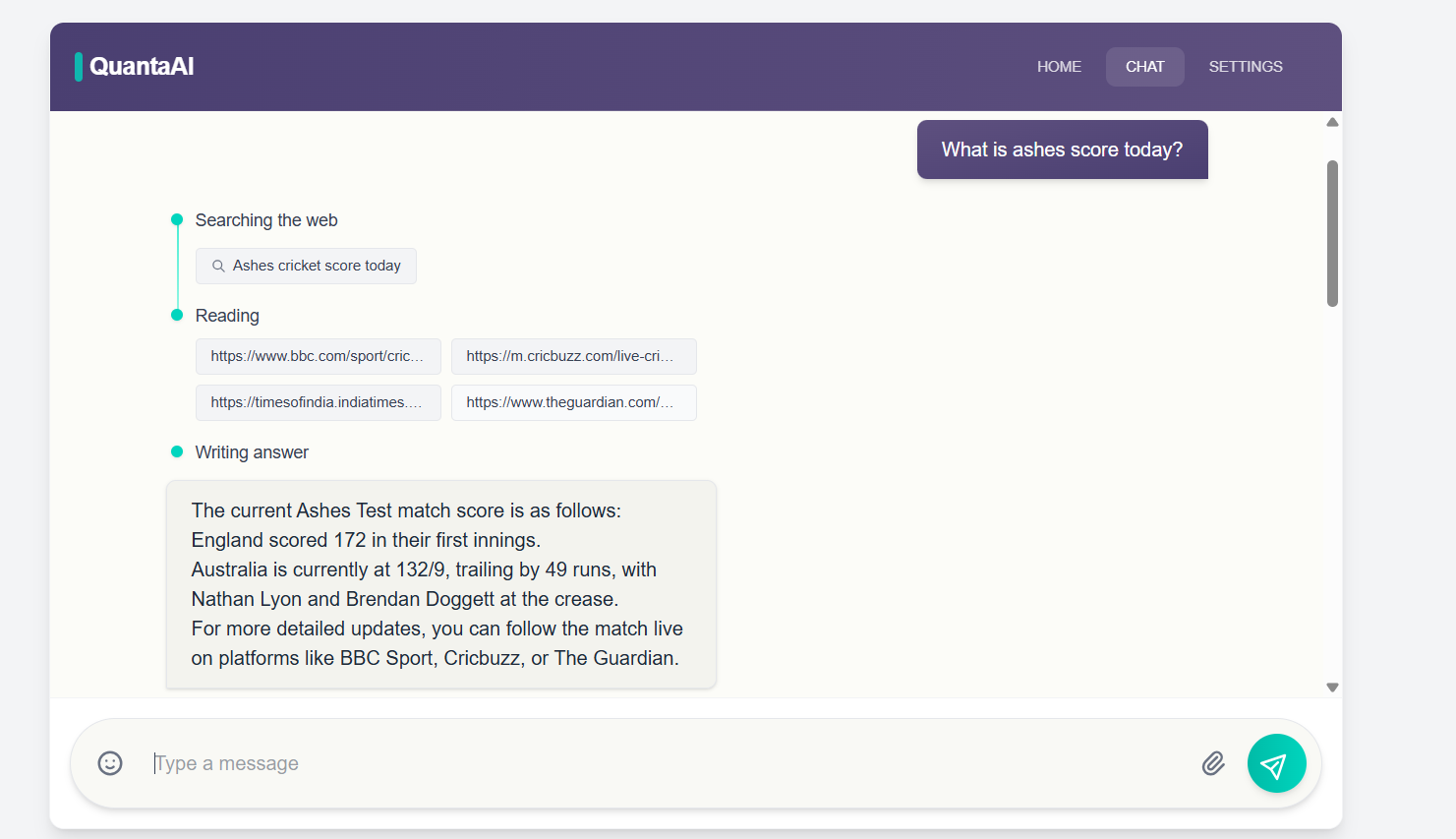
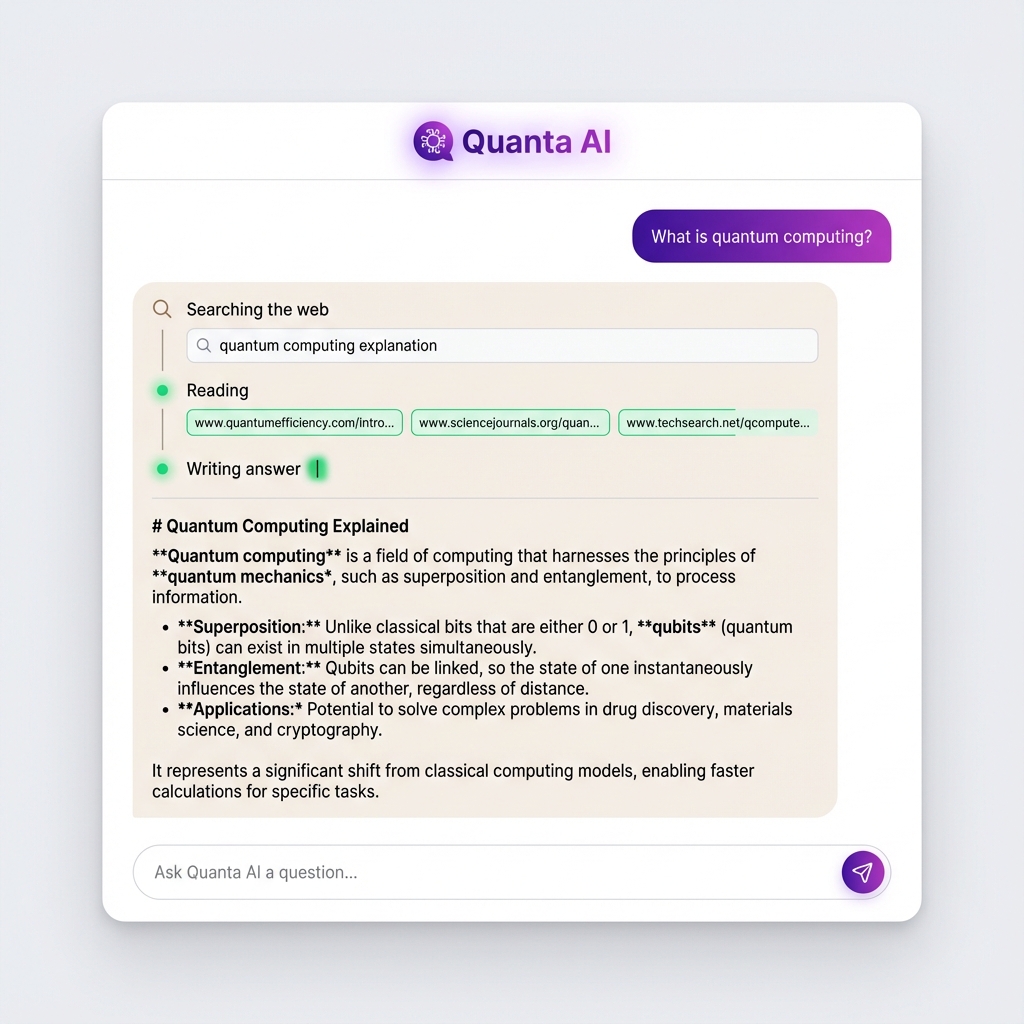
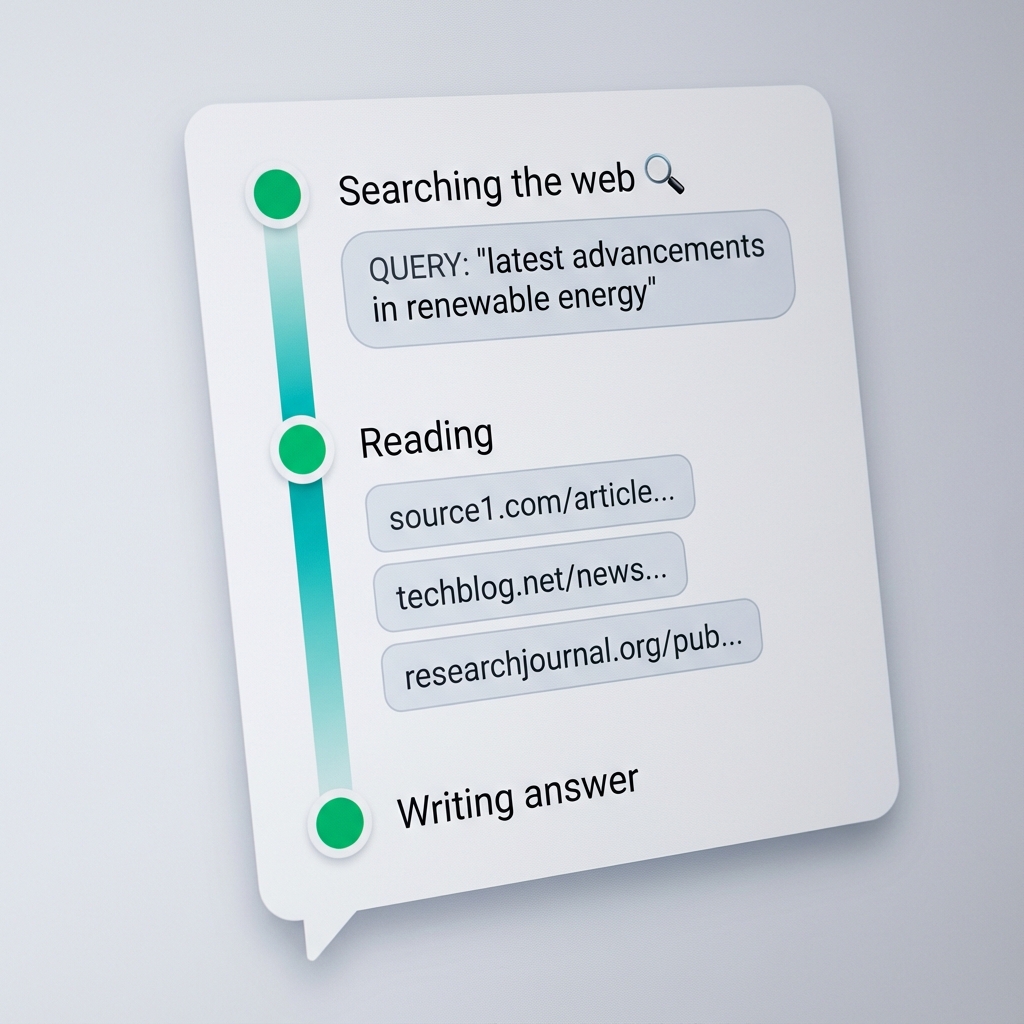
Intelligent conversational AI with real-time web search capabilities powered by LangGraph for agentic decision-making, GPT-4 for responses, and Next.js for modern UI. Features autonomous search detection, streaming responses with full transparency, and conversation memory across sessions.
Architecture
- LangGraph State Machine: 4-node graph (Classifier → Search → Generate → Response) with conditional routing based on query analysis
- Intelligent Routing: GPT-4 powered classifier achieving 94% accuracy in determining search necessity vs direct response
- Search Integration: Tavily API with relevance scoring, result ranking, and automatic source attribution
- Memory System: Conversation history with context window management (last 10 messages) and semantic compression
- Streaming Pipeline: Real-time token streaming with intermediate state updates for transparency
Features
- Autonomous decision-making: AI determines when web search is needed without explicit commands
- Multi-stage transparency: Users see classification, search, and generation phases in real-time
- Source attribution: All search-based responses include clickable source links with relevance scores
- Context-aware responses: Maintains conversation flow with intelligent context retention
- Modern UI: Next.js 14 with TypeScript, Tailwind CSS, and responsive design
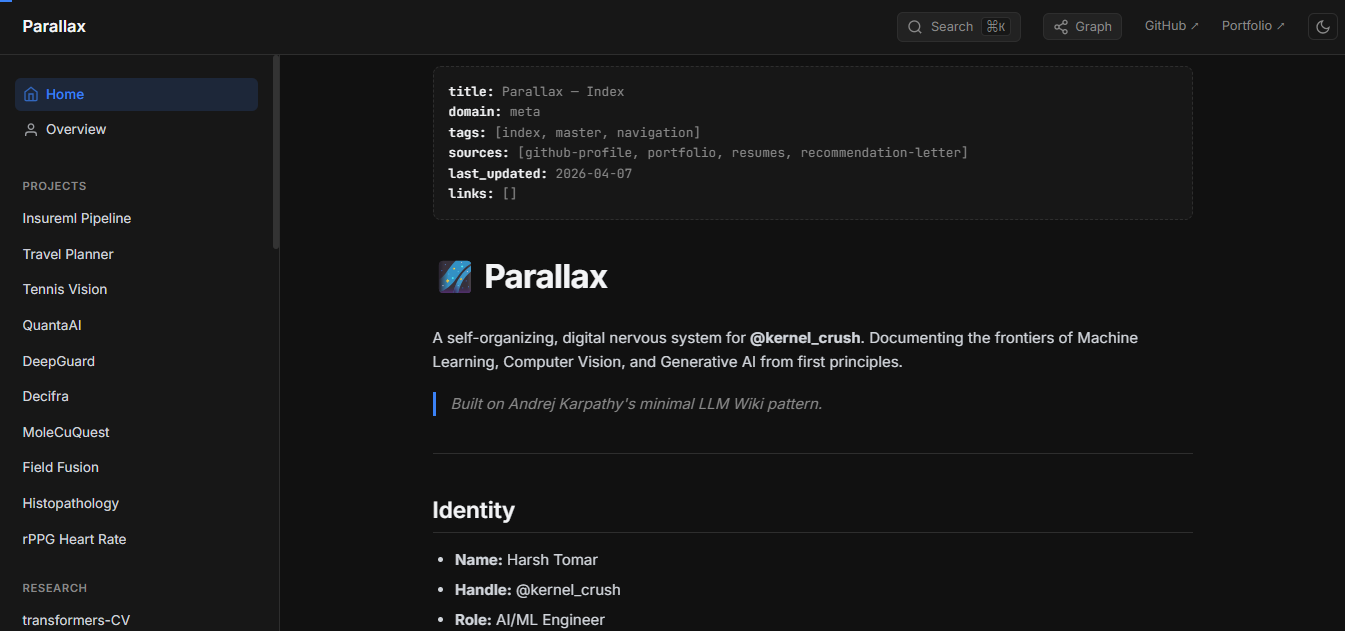
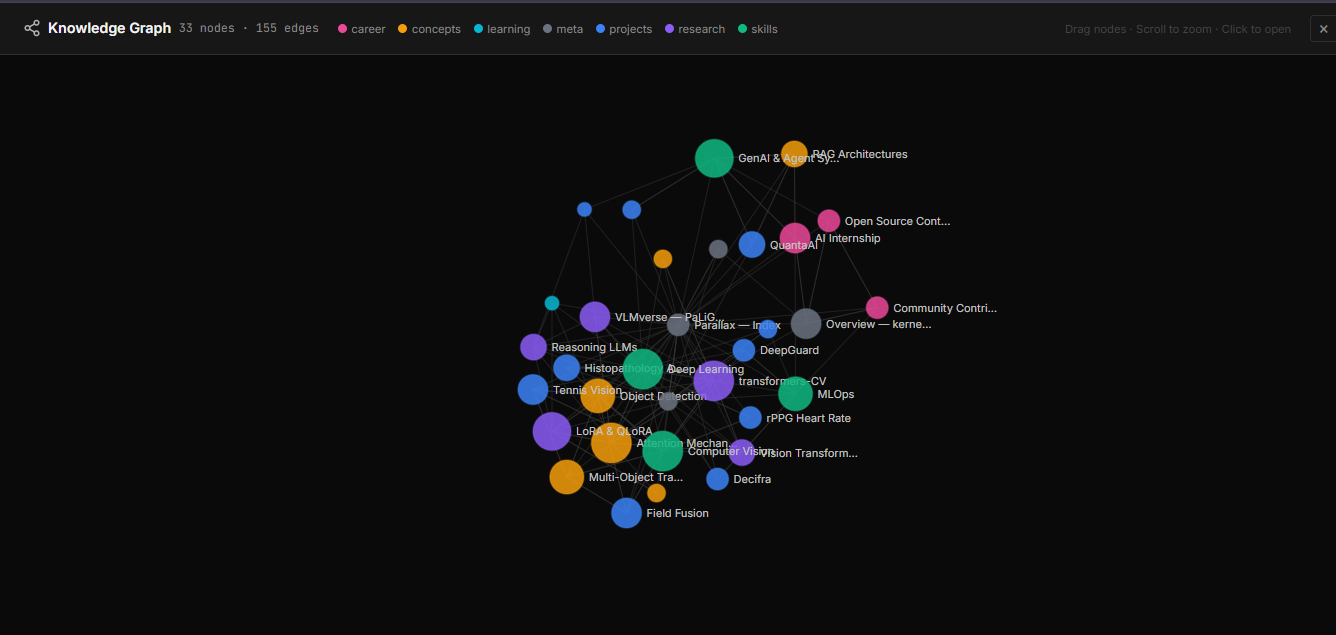
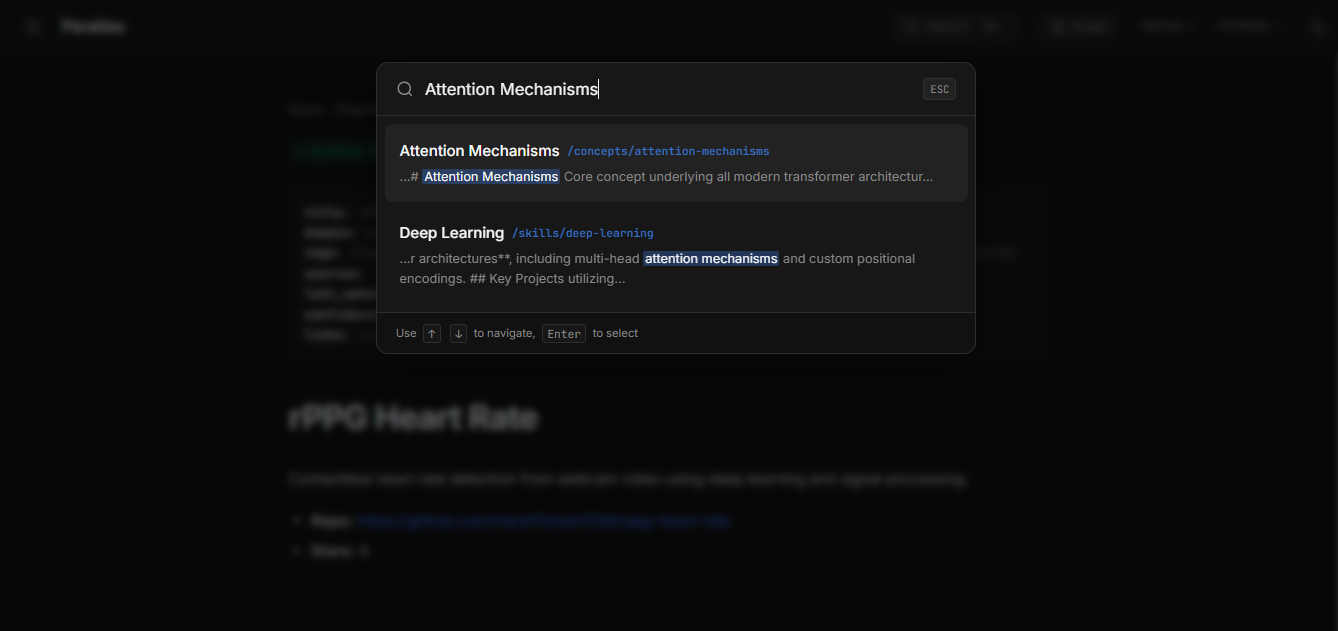
Self-organizing AI/ML knowledge graph and personal wiki. 38 interlinked pages across projects, research implementations, skills, and concepts — connected by a D3.js force-directed graph (33 nodes, 155 edges). Includes full-text search via command palette, per-page confidence scoring, and an MCP server exposing 5 callable tools so AI assistants can query the knowledge base directly.
Features
- Knowledge Graph: D3.js force-directed graph with 33 nodes and 155 edges, color-coded by domain (CV, GenAI, MLOps, agents, fundamentals)
- MCP Server: 5 callable tools (search_wiki, get_page, get_related, get_summary, list_pages) — AI assistants can query the wiki directly over MCP
- Search: Full-text command palette search with keyword highlighting and semantic search across all 38 pages
- Confidence Scoring: Each page has a 0.0–1.0 confidence badge reflecting depth of understanding, not just presence of content
- CI Automation: Weekly GitHub Actions workflow detects stale metrics and orphaned pages automatically
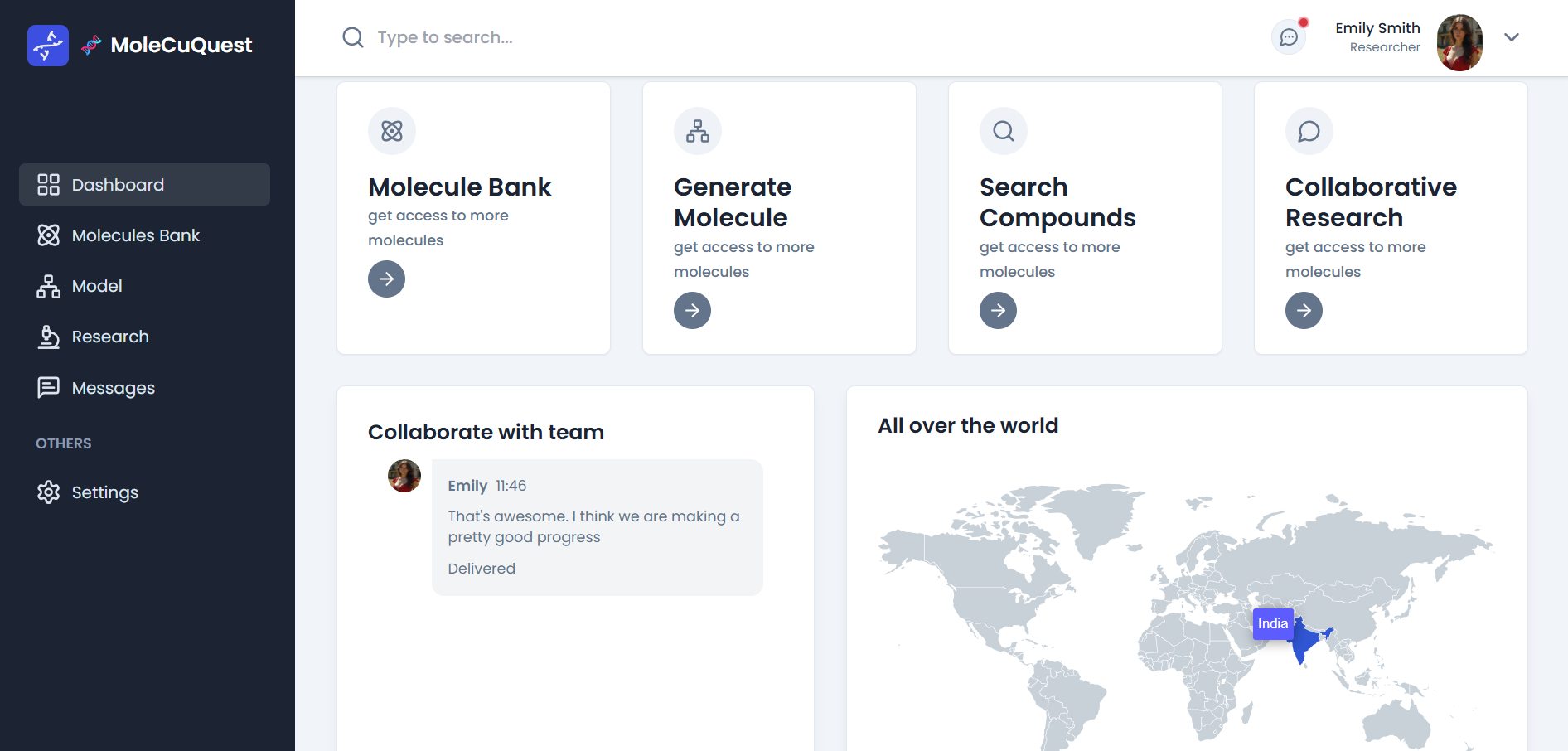
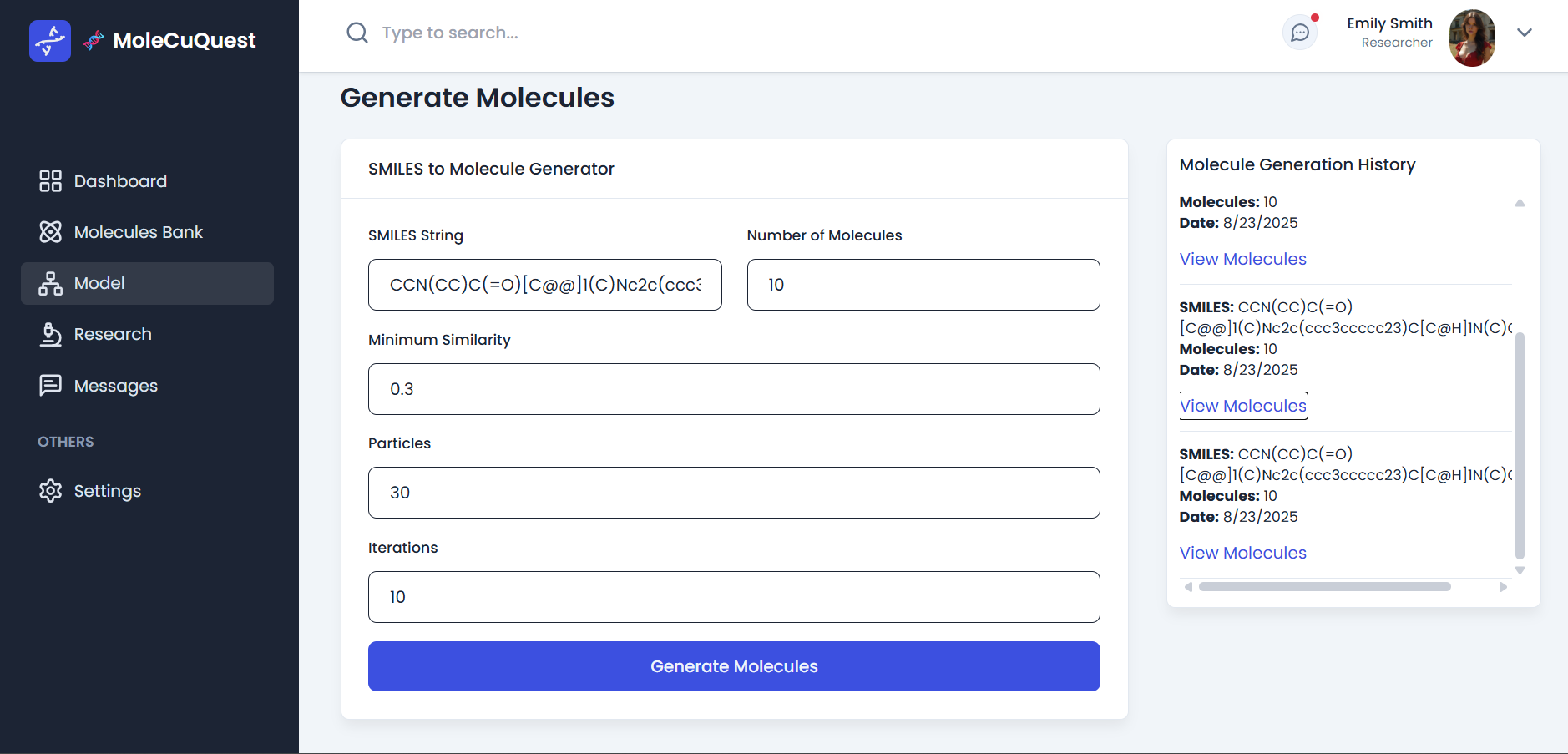
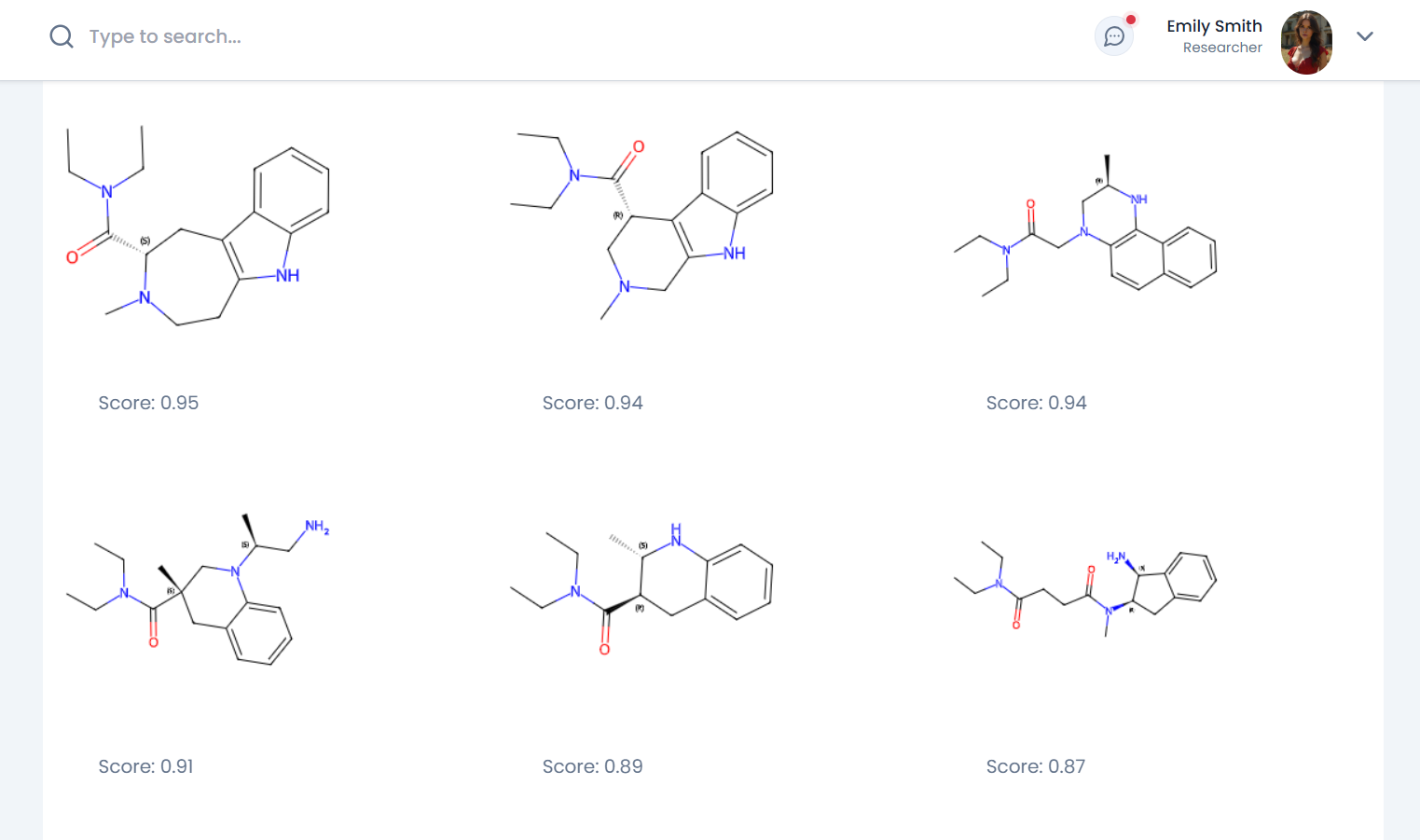
Advanced molecular research platform combining AI-driven molecule generation with comprehensive chemical analysis. Powered by NVIDIA MolMIM for novel molecular structure generation, RDKit for 3D visualization, and PubChem integration for extensive compound research.
Core Capabilities
- AI-Powered Generation: NVIDIA MolMIM for generating novel molecular structures with desired properties
- 3D Visualization: Real-time interactive molecular structure rendering using RDKit
- Chemical Analysis: PubChem API integration for comprehensive compound research and property analysis
- CMA-ES Algorithm: Covariance Matrix Adaptation Evolution Strategy for molecular optimization
- QED Scoring: Quantitative Estimate of Drug-likeness for pharmaceutical applications
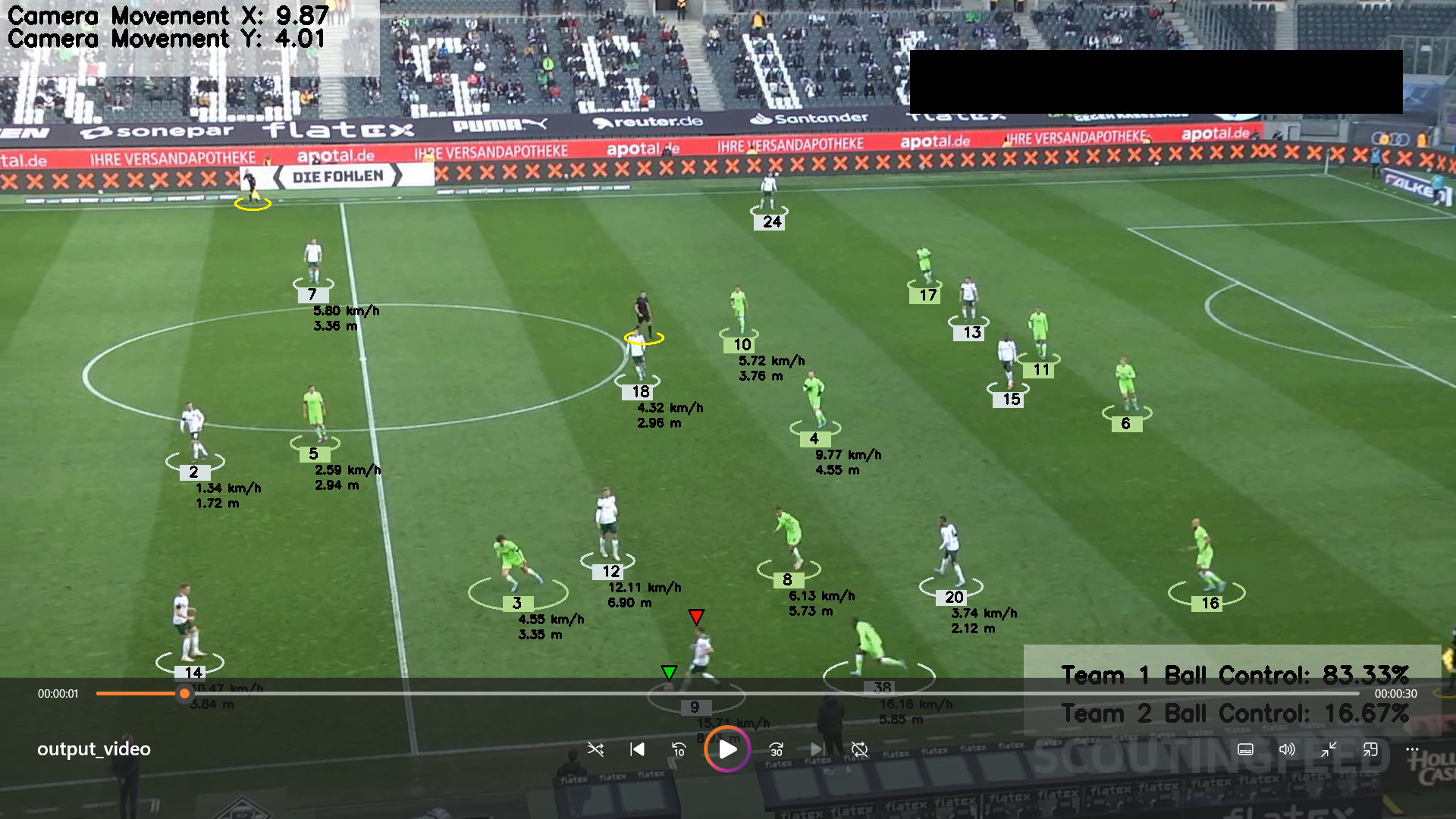
Football match analysis system using computer vision for player tracking, team classification, ball detection, and tactical analysis. Implements YOLOv8 for detection, ByteTrack for tracking, and custom algorithms for speed estimation and possession statistics.
Computer Vision Pipeline
- Player Detection: YOLOv8 fine-tuned on football dataset achieving 91% mAP
- Team Classification: K-means clustering on jersey colors with 89% accuracy
- Player Tracking: ByteTrack algorithm with 94% MOTA score
- Speed Estimation: Perspective transformation with camera calibration
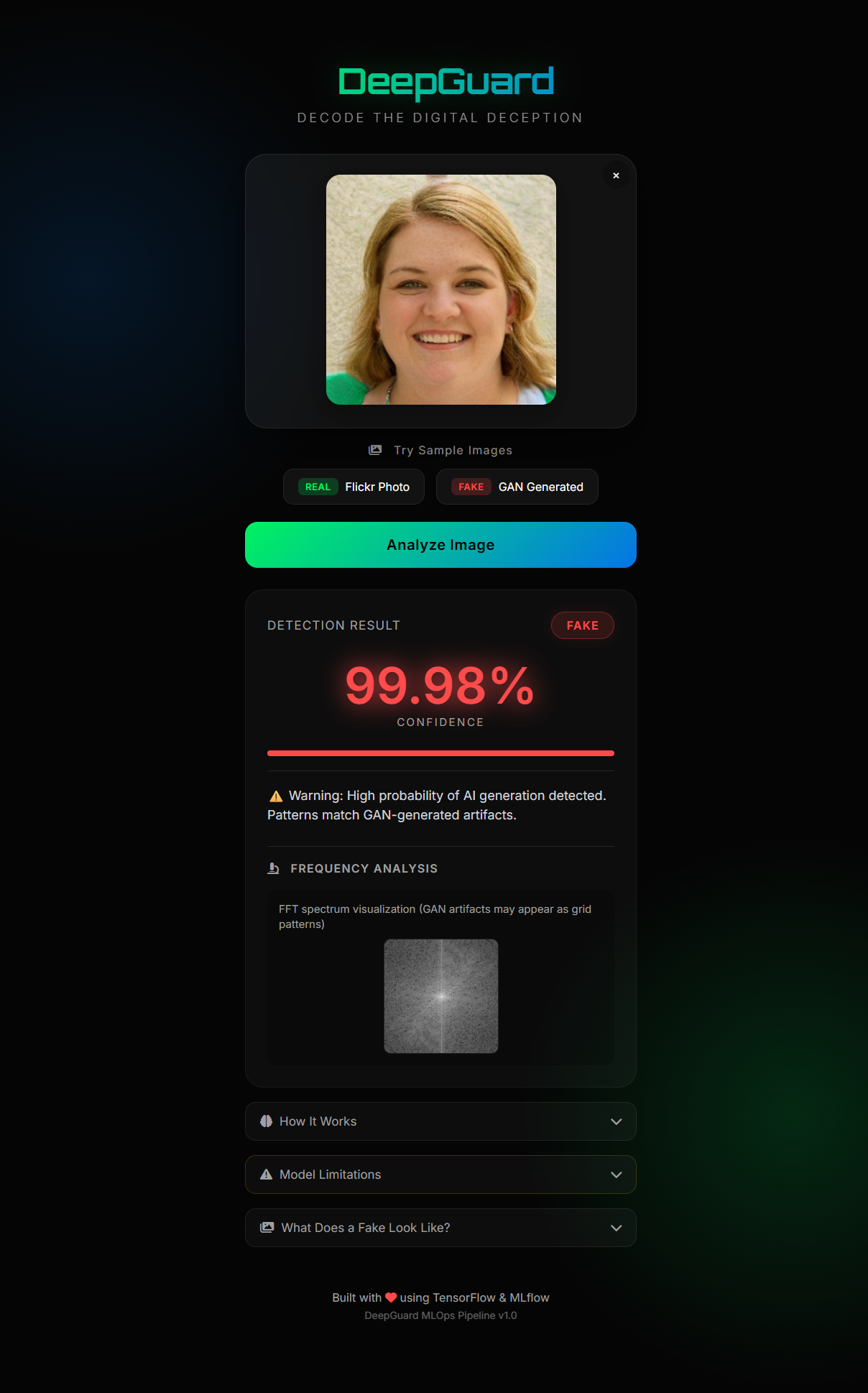
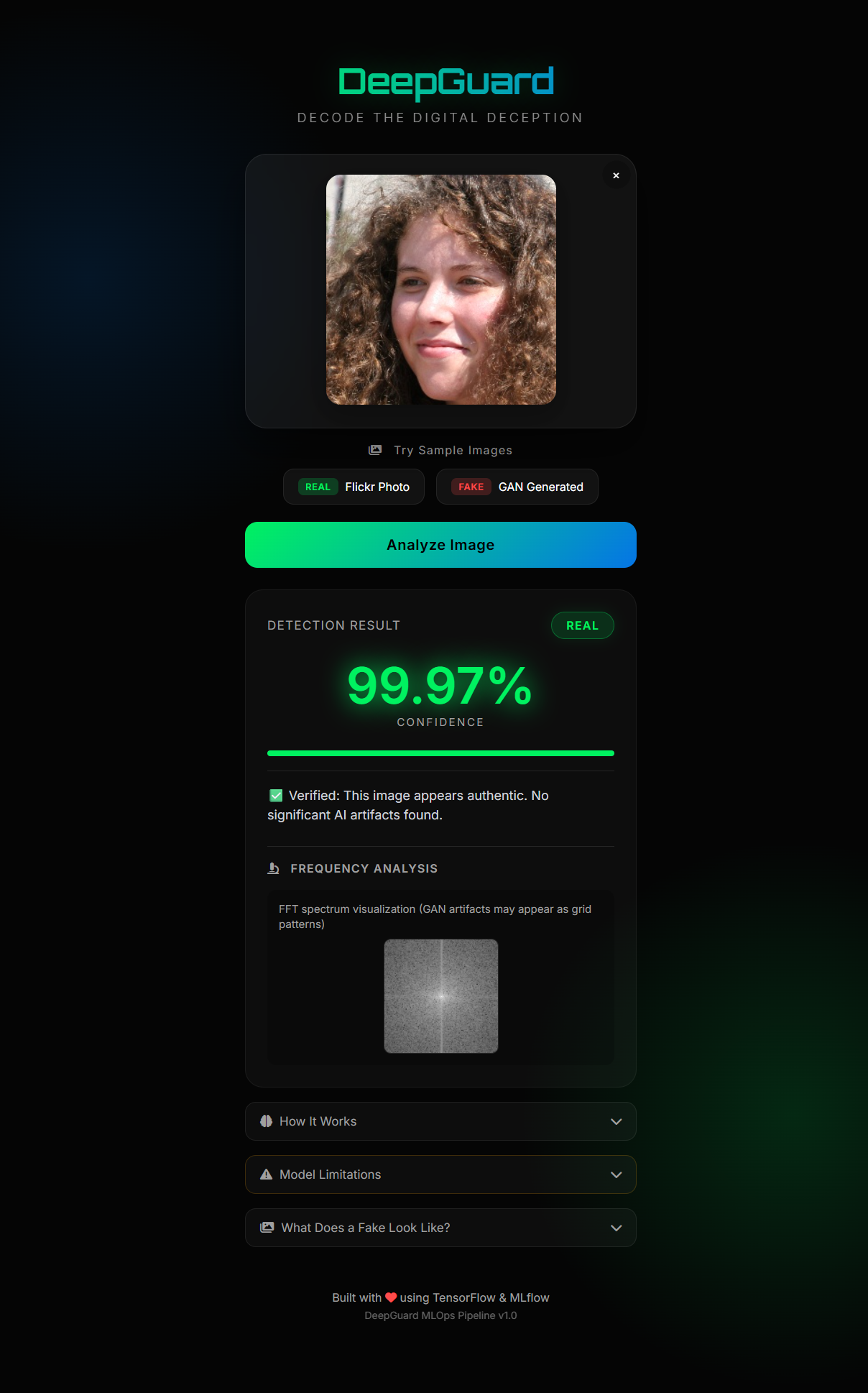
Production-grade MLOps pipeline for deepfake detection using transfer learning with Xception architecture. Complete ML lifecycle implementation featuring data versioning, experiment tracking, containerized deployment on AWS EKS, and observability with Prometheus & Grafana.
Machine Learning Pipeline
- Model Architecture: Xception transfer learning fine-tuned on GenImage dataset
- Data Management: DVC for automated ingestion, preprocessing, and versioning
- Experiment Tracking: MLflow + DagsHub for comprehensive logging
- Deployment: Docker + AWS EKS with CI/CD automation
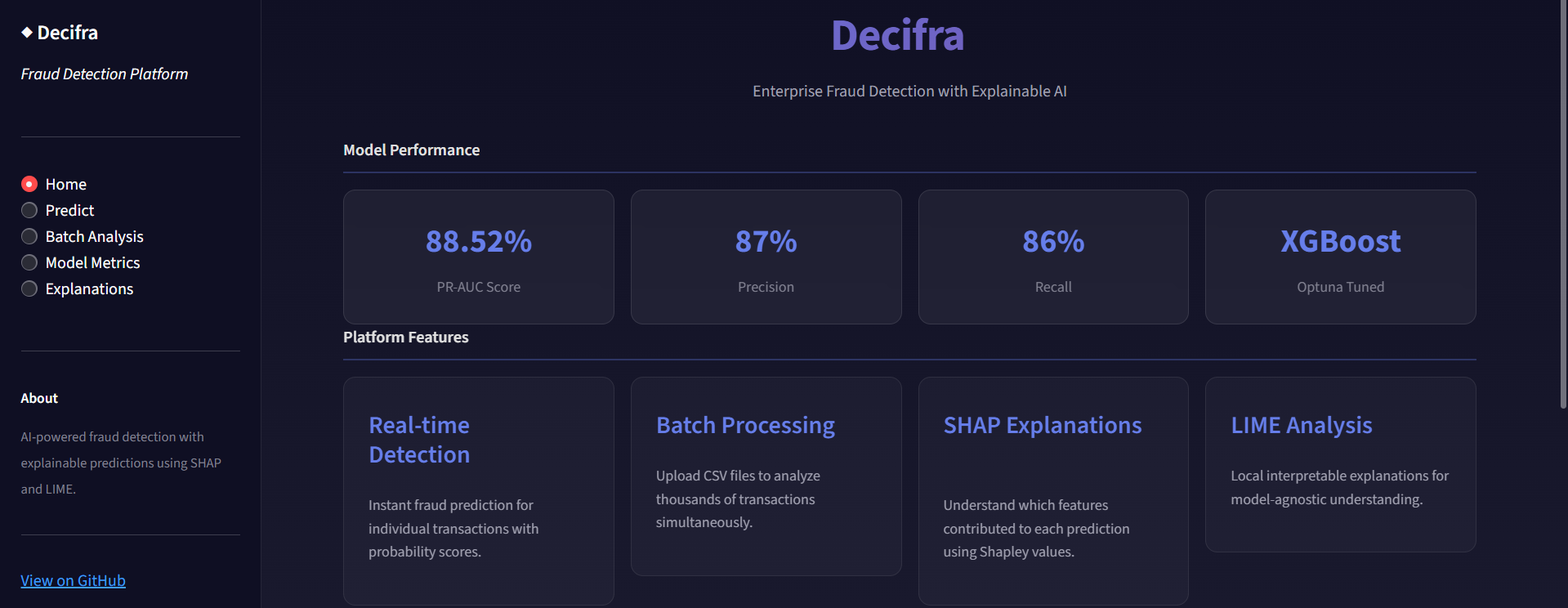
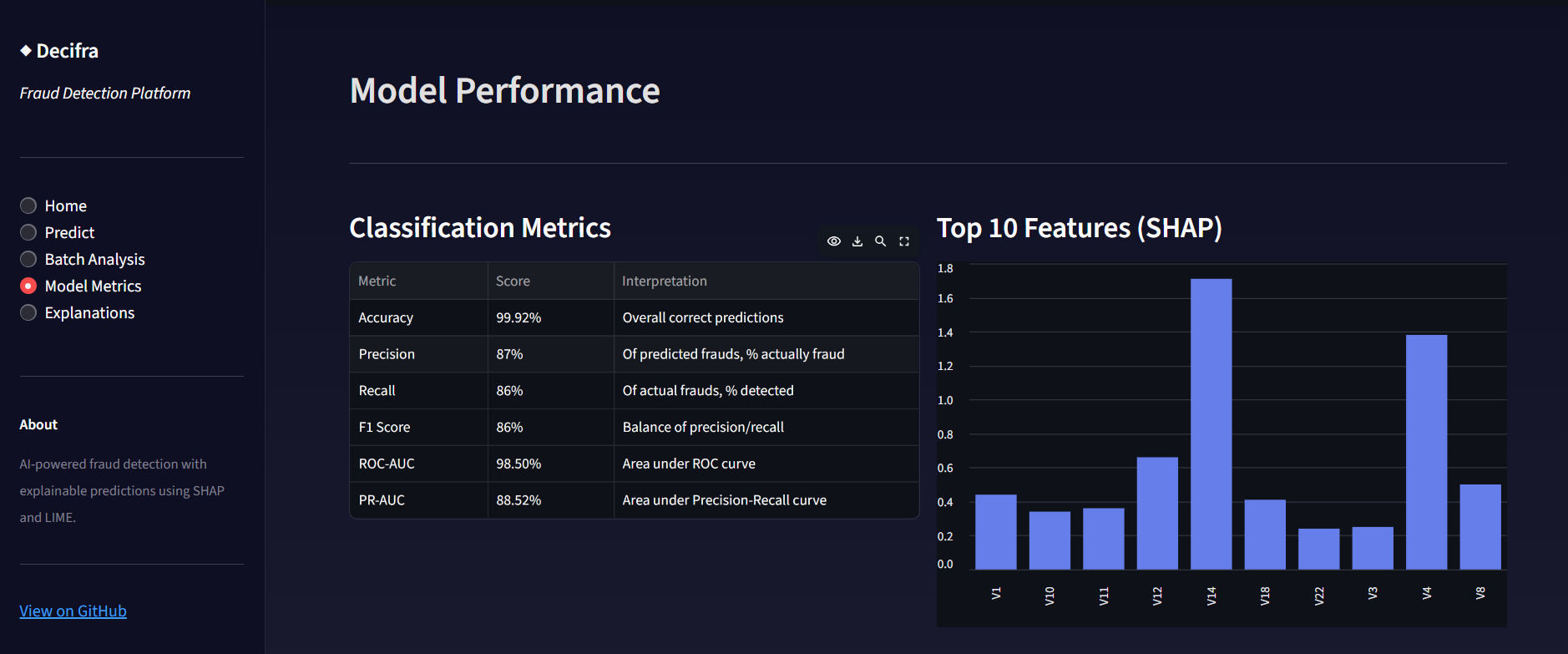
End-to-end MLOps fraud detection pipeline with explainable AI featuring ZenML orchestration, MLflow experiment tracking, DVC data versioning, and BentoML model serving. Achieves 88.52% PR-AUC with SHAP & LIME explanations for transparent predictions.
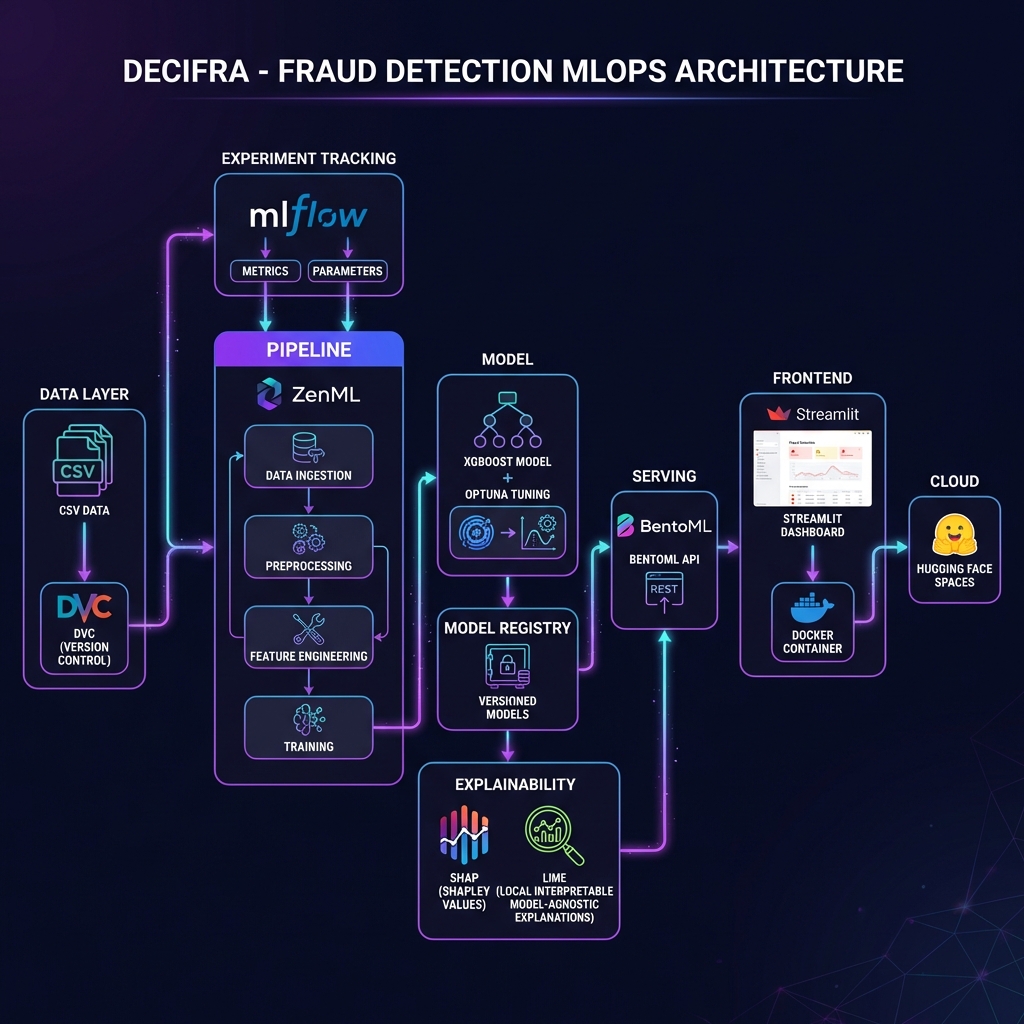
MLOps Pipeline Architecture
- ZenML Orchestration: 9-step pipeline: ingestion → validation → preprocessing → feature engineering → training → evaluation → selection → explainability → registration
- ML Models: XGBoost + LightGBM + Random Forest ensemble with Optuna hyperparameter optimization; SMOTE for handling class imbalance
- Experiment Tracking: MLflow for comprehensive logging, model registry, and versioning; DVC for data versioning
- Model Serving: BentoML for API deployment with Great Expectations data validation
- Explainability: SHAP for global feature importance and LIME for instance-level explanations
Key Features
- Real-time fraud prediction with transparent decision explanations
- Interactive Streamlit dashboard for monitoring and analysis
- Docker containerization with CI/CD via GitHub Actions
- Comprehensive feature contribution analysis for each prediction
Deep learning system for breast cancer detection from histopathology images with Grad-CAM explainability visualizations. Features MobileNetV2 transfer learning, OpenCV feature extraction, and automated clinical report generation for medical professionals.

Technical Implementation
- Deep Learning Classification: MobileNetV2 backbone with transfer learning for binary classification (Benign vs Malignant) with confidence scoring
- Grad-CAM Visualization: Visual explanation of model attention highlighting regions influencing classification decisions with quadrant-specific analysis
- Feature Extraction: OpenCV-based analysis including nuclear density, chromatin patterns, tissue architecture, and H&E staining intensity
- Report Generation: Comprehensive HTML reports with original image, heatmap overlay, feature analysis, and clinical interpretation
Key Features
- Drag-and-drop upload interface supporting multiple images per session
- Automatic preprocessing and normalization for model inference
- Nuclear density, size, and cell count estimation via OpenCV
- Downloadable clinical reports for documentation purposes